#11
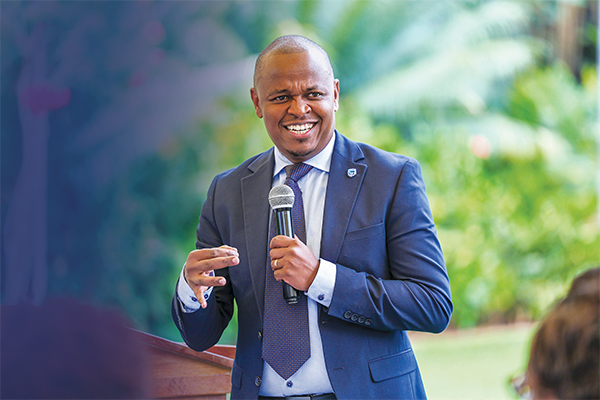
RENATO D’SOUZA
DIRECTOR, BUSINESS BANKING
ABSA BANK KENYA PLC
Reimagining Business Banking Around the Realities of Enterprise Growth
For many Kenyan businesses, particularly small and medium-sized enterprises, access to finance has never been simply a question of whether a bank has money to lend. The harder questions concern information, risk assessment, cash-flow visibility, collateral, business capability and the ability of financial institutions to understand an enterprise beyond the conventional balance sheet. It is within this changing environment that Renato D’Souza, Business Banking Director at Absa Bank Kenya, has taken on a role with implications extending well beyond the management of a banking portfolio.
D’Souza returned to Absa Bank Kenya in 2026 after serving at Stanbic Bank Kenya, where he was Head of Commercial Banking.
His career spans more than 15 years across Corporate & Investment Banking and Business & Commercial Banking. His return is particularly significant because he previously began his banking career at Absa, then Barclays Bank, in 2003, bringing to the institution both familiarity with its culture and experience gained elsewhere in the banking industry.

His professional grounding combines banking with strategic management, starting with a Bachelor of Arts (BA) degree in Building Economics and Management from the University of Nairobi (UoN) and an MBA degree in Business Administration, Strategic Management.
D’Souza’s current mandate makes his experience particularly relevant to the future of Kenyan business banking. Moving beyond the traditional lending model, Kenya’s SME sector presents banks somewhat with a paradox. It represents a substantial part of economic activity and employment, yet many enterprises struggle to obtain appropriate formal credit. D’Souza has articulated the challenge in terms of a sizeable financing gap. In a September 2026 discussion on NTV Kenya’s Business Redefined, he pointed to the continued difficulty SMEs face in accessing formal credit and described Absa Bank’s efforts to use digital scorecards and alternative data in assessing businesses, marking an important shift in the mechanics of business banking.
Traditional lending has often placed heavy emphasis on collateral and conventional financial records. Digital banking creates the possibility of a broader assessment of an enterprise’s economic activity. Transactional behaviour, cash flows and other relevant data can potentially provide additional insight into the capacity of a business to borrow and repay. For D’Souza, therefore, technology is not merely a channel through which banking services are delivered. It is becoming part of the infrastructure through which financial institutions understand their customers. That distinction could prove important for the next generation of Kenyan enterprises.

Making finance part of a wider growth ecosystem, D’Souza’s approach is also visible in Absa Bank’s efforts to combine financial services with business capability. In June 2026, Absa Bank Kenya entered a partnership with Google’s Hustle Academy aimed at reaching 3,000 SMEs over a 12-month period. More than 600 entrepreneurs had already participated through the first three cohorts reported at the time of the announcement. The programme combines digital-skills development, business training, mentorship and financial support, according to the influential business media, Bizna Kenya.
The significance lies in the combination. Capital alone does not necessarily produce a scalable business. An entrepreneur may require better financial management, digital capability, market access and stronger operational systems before additional borrowing can translate into growth which leads to sustainable expansion. Under the Absa-Google initiative, Absa Bank is providing financial expertise, mentorship and access to SME banking solutions including credit facilities, cash-flow management tools and market linkages, according to Bizna Kenya.

For Business Banking, this represents a broader conception of the bank’s role: not simply financing an established business, but helping create the conditions under which a business can become more formal, more productive and potentially more bankable.
Bringing a commercial banking perspective to SMEs, D’Souza’s previous experience in commercial banking is particularly relevant. Business banking sits at an intersection where entrepreneurs need the responsiveness associated with SME banking while increasingly demanding the sophistication associated with larger corporate finance. As businesses grow, their needs evolve from basic working capital into asset finance, trade finance, payments, cash management, investment and expansion funding. A business bank therefore has to understand the enterprise’s trajectory rather than merely its current size. This is where D’Souza’s experience across Corporate & Investment Banking and Business & Commercial Banking provides a useful convergence and perspective.
D’Souza’s career so far has exposed him to businesses at different stages and with different financing requirements, giving him a professional base from which to approach business banking as a continuum rather than a collection of isolated products.
Another emerging feature of his leadership is the emphasis on partnerships. Absa Bank’s engagement with Google demonstrates how financial institutions can work with technology companies to address challenges that neither banking nor technology can solve independently. Similar thinking was evident in Absa Bank’s collaboration with Simba Corporation to expand access to asset financing for commercial vehicles, passenger cars and agricultural equipment. The partnership announced financing arrangements aimed at supporting SMEs, families and farmers. Such partnerships reflect an increasingly interconnected business environment.

Enterprises need finance, but they also need equipment, technology, customers, supply chains and market access. The business bank of the future may consequently be judged not only by the size of its loan book, but by the quality of the ecosystem it can assemble around its customers.
The traditional relationship between banker and business owner is being supplemented by data, digital platforms, alternative credit assessment, ecosystem partnerships and financial education. At the same time, banks must continue to balance accessibility with prudent risk management. That balance is central to the future of SME finance. Easier access to credit is valuable only when it is matched by responsible lending, appropriate pricing, sound cash-flow management and enterprises capable of deploying capital productively.
D’Souza’s contribution, therefore, is not simply about expanding access to banking products. It is about helping redefine how a bank interacts with the businesses that form the backbone of Kenya’s entrepreneurial economy. His return to Absa Bank has placed him at the centre of that transition. With experience spanning corporate, commercial and business banking, and with a visible emphasis on digital assessment, partnerships and enterprise capability, his mandate reflects a banking industry increasingly focused on understanding the complete business rather than merely the borrowing request.
D’Souza represents the next phase of enterprise growth, that is becoming one of the most consequential shifts in business banking: moving from financing businesses as they are to building financial relationships and ecosystems capable of supporting what those businesses can become and bringing a human touch to financial services, in order to turn possibilities into realities.