#6
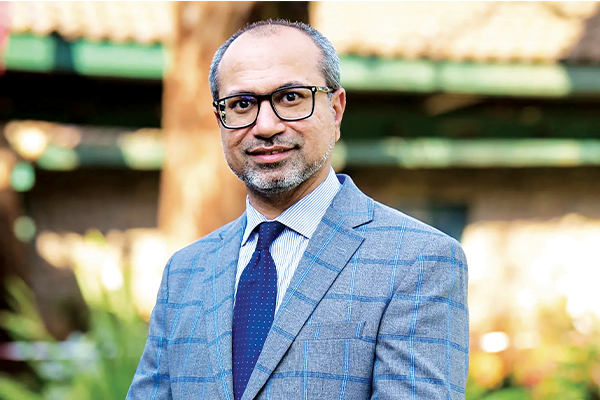
AMIN DHARSI
REGIONAL DIRECTOR, PURCHASING & SUPPLY CHAIN MANAGEMENT DIVISION
AGA KHAN UNIVERSITY & AGA KHAN HEALTH SERVICES
Re-engineering the Supply Chain Behind the Digital Hospital
In modern healthcare, some of the most consequential decisions are made far from the consulting and surgical rooms. The availability of a critical medicine, surgical supplies, the reliability of medical equipment, the speed at which a diagnostic service can be delivered, the cost of maintaining sophisticated technology and the ability of a hospital to respond to changing patient demand all depend on systems that patients rarely see. This is the less visible architecture of healthcare — procurement, sourcing, negotiations, logistics and supply-chain management. It is also where Amin Dharsi has built his career.
As Regional Director of the Purchasing & Supply Chain Management Division (PSCMD) for Aga Khan University and Aga Khan Health Services, Dharsi operates at the intersection of healthcare, supply chain, technology and operational efficiency. His remit extends beyond purchasing products. It sits within a healthcare ecosystem in which the quality, availability and cost of resources can directly influence the ability of clinicians to deliver care. That makes supply-chain management an increasingly strategic function.
Dharsi’s professional standing was recognised in 2025 when he was named Supply Chain Leader of the Year at the Fortinus Events Supply Chain & Logistics Summit East Africa (SCLSEA). The recognition came as healthcare organisations across the region were confronting the need to strengthen procurement, improve resilience and extract greater value from increasingly complex supply networks.

The significance of his role becomes clearer when viewed against the transformation taking place within Aga Khan’s healthcare operations. A hospital today is no longer simply a physical institution stocked with medicines, surgical, laboratory and radiology consumables and medical equipment. It is a data-rich operating environment involving electronic health records, digital patient services, advanced diagnostic equipment, artificial intelligence, specialised clinical systems and increasingly sophisticated infrastructure. Aga Khan University Hospital, Nairobi has already moved substantially in this direction. Its electronic health-record system allows patients to access personal health information, test results, appointments and other services through a patient portal. The hospital describes the initiative as part of a wider Aga Khan University digitisation programme aimed at moving hospitals and outreach centres towards paperless operations.
Such transformation changes the nature of procurement. Buying medical equipment is no longer simply a matter of comparing prices and specifications. A sophisticated healthcare technology purchase can involve software integration, cybersecurity, data compatibility, maintenance, clinician and technical staff training, life cycle costing, availability of spare parts, upgrades and updates of hardware/software, licensing, interoperability and the long-term availability of technical support. The supply chain therefore becomes part of the digital strategy. That shift is particularly relevant as Aga Khan University Hospital and Aga Khan Health Services expand their use of advanced technology.

In March 2026, Aga Khan University Hospital Nairobi unveiled an AI-enabled radiotherapy system costing KSh800 million, designed to increase precision in cancer treatment while reducing treatment times. The hospital has also reported a wider investment in artificial intelligence and advanced medical technology, including AI-enabled imaging intended to accelerate diagnostic processes and support expansion into secondary care. In addition, the East Africa region has witnessed significant advances in healthcare technology led by the AKDN Health system, including the installation of a state-of-the-art helium-free 1.5T MRI machine at Aga Khan Hospital in Dar es Salaam, Tanzania. In Nairobi, East Africa’s first robotic-assisted surgery was performed at Aga Khan University Hospital, marking a significant milestone in the advancement of minimally invasive surgical techniques across the region.
Behind such investments lies a procurement question that is considerably more complicated than obtaining the equipment. How does a healthcare organisation determine whether a technology represents genuine clinical and operational value? How should it assess lifecycle costs rather than simply acquisition prices? How can it ensure that equipment can be maintained and supported over many years? And how can a regional healthcare network standardise procurement while allowing individual facilities to respond to local requirements? These are strategic questions for the supply-chain function. Dharsi’s role therefore provides an opportunity to look at healthcare transformation from an angle that is frequently overlooked.
Much of the public conversation about digital healthcare focuses on doctors, artificial intelligence, electronic records and patient applications. Yet none of these technologies can operate effectively without the infrastructure, vendors, equipment, medicines, data systems and service agreements supporting them. Supply chain is increasingly the bridge between innovation and implementation. The challenge is also financial. Healthcare institutions operate in an environment where technology costs can be substantial, imported equipment can expose organisations to currency and logistics risks, and medical supplies have consequences that extend well beyond conventional inventory management. A shortage of an ordinary commercial product may inconvenience a customer. A shortage of a critical medical supply can disrupt clinical and patient care. That difference places an unusually high premium on forecasting, supplier management, quality assurance and resilience. For a regional healthcare organisation, the complexity becomes greater still. Purchasing decisions have to take account of different markets, regulations, clinical requirements and operating environments. Standardisation can create economies of scale, but excessive standardisation can fail to recognise local realities. The strategic objective is therefore not simply to buy more efficiently. It is to create a supply system capable of supporting clinical excellence while controlling cost and managing risk. This is where Dharsi’s role intersects with the broader evolution of the Aga Khan health system.

The institution’s digital transformation has already demonstrated that healthcare technology can alter the patient experience. Electronic records can reduce dependence on paper and make information more accessible. Digital systems can improve continuity of care and create data that can support research. AI-enabled technologies can potentially accelerate diagnosis and improve the precision of treatment. But technology does not eliminate operational complexity. It creates new forms of it. The supply chain executive of the modern hospital must consequently understand not only price and supply, but also technology, data, clinical workflows, vendor capability, after-sales & support, lifecycle management and organisational change. That is the larger story behind Dharsi’s position.
Dharsi believes that these achievements cannot be accomplished alone. He places strong emphasis on teamwork, mentorship, and continuous capacity building, recognizing that developing people is fundamental to the success and sustainability of healthcare supply chains.
Under his leadership, he actively invests in the professional development of his supply chain team through mentorship, training, and opportunities for continuous learning. His commitment extends beyond his immediate team to young graduates aspiring to build careers in supply chain management. He also promotes a culture of motivation and recognition by encouraging and rewarding outstanding performance. Through a quarterly recognition programme, team members and teams are acknowledged for their contributions through awards such as “Best Team” and individual performance awards. These initiatives foster a culture of excellence, engagement, and continuous improvement while strengthening the next generation of healthcare supply chain professionals.
His contribution to healthcare transformation is therefore best understood not through a list of purchases, but through the systems that allow clinical innovation to function at scale. In an industry where patient care is increasingly dependent on interconnected technology and highly specialised resources, the supply chain has moved closer to the centre of strategy. Amin Dharsi operates in that increasingly important space — where procurement meets healthcare innovation, where supply-chain discipline meets digital transformation, and where decisions made behind the scenes ultimately influence what happens at the point of care. For Aga Khan University Hospital and Aga Khan Health Services’ expanding healthcare network, the strategic challenge is to ensure that innovation does not remain confined to impressive equipment or sophisticated software. It must translate into reliable services, efficient operations, accessible expertise and better experiences for patients. That is why the future of healthcare will not be shaped only in operating theatres, laboratories and consultation rooms. It will also be shaped by the quality of the systems that keep those environments functioning. And increasingly, those systems begin with the supply chain — Amin Dharsi’s playground.