#8
FAITH BASIYE
GROUP CHIEF RISK OFFICER
KCB GROUP
The Risk Strategist Turning Prudence into Growth
At KCB Group, the Chief Risk Officer is helping redefine risk—not as a brake on ambition, but as one of the disciplines that makes sustainable growth possible.
In banking, some of the most consequential decisions are made long before a customer sees a new financial services product, a business secures financing or a market celebrates another year of growth. They are made in the rooms where leaders ask hard questions. What could change? What could go wrong? Where is the opportunity hidden inside the uncertainty? And how can an institution move decisively without compromising the trust on which its future depends?
For Faith Basiye, these are not theoretical questions. They are central to her mandate as Group Chief Risk Officer of KCB.
Appointed to the role in July 2024, Basiye is part of KCB Group’s senior executive leadership responsible for helping the institution navigate an increasingly complex operating environment. KCB’s latest reporting places her within a Group Executive Committee whose mandate includes ensuring that the organisation remains positioned to capitalise on opportunities for growth.
At the KCB Group, “The modern risk leader is no longer simply guarding the gates. The role is increasingly about helping an organisation understand which gates are worth opening—and under what conditions.” That evolution is particularly significant in African banking, where digital transformation, financial inclusion, cybersecurity, regulatory expectations and changing customer behaviour are converging at remarkable speed.
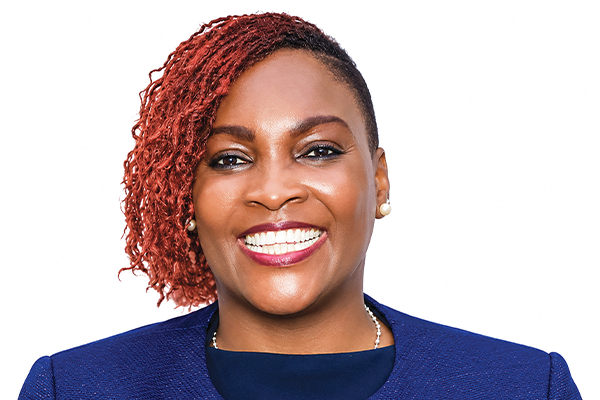
With a career built at the intersection of risk and opportunity, Basiye’s professional journey gives her a perspective that reaches well beyond conventional risk management. Her belt holds more than 26 years of experience spanning risk management, legal advisory, compliance and forensic investigation. Before becoming Group Chief Risk Officer, she served as KCB Group’s Head of Forensic Services. Her earlier career included forensic work at the Kenya Anti-Corruption Commission, experience at KPMG, and a senior fraud-management role at Safaricom PLC.
According to her, it is a combination that matters. Forensic investigation teaches an executive to look beyond symptoms to causes. Legal training brings an appreciation of governance, accountability and regulatory obligations. Financial-crime experience demands attention to detail, while enterprise risk requires the ability to see how individual threats can interact across an entire organisation. Basiye brings and holds these disciplines together.
Her academic and professional qualifications include a Bachelor of Laws degree, a Post Graduate Diploma in Legal Studies, Certified Public Secretary (Kenya), Certified Fraud Examiner and Computer Forensics Expert credentials. The resultant knowledge is a leadership profile suited to an era in which the boundaries between operational, financial, technological and reputational risk are increasingly blurred.
When risk becomes a growth discipline
There was a time when risk departments could be perceived primarily as control functions—necessary guardians whose job was to prevent excessive exposure. That model is changing. For a financial institution pursuing growth across markets and customer segments, risk intelligence can directly influence the quality and speed of strategic decisions. KCB’s own governance framework describes risk management as a means of maintaining the Group’s stability while supporting achievement of business objectives. Its Enterprise Risk Management Framework is designed to ensure that material risks are identified and assessed and that exposures are managed within an agreed risk appetite.
This is where the strategic importance of Basiye’s role becomes clear. A bank cannot responsibly expand lending without understanding credit risk. It cannot accelerate digital services without addressing cyber and fraud risks. It cannot introduce new technologies without considering data, governance and operational implications. The challenge is not to eliminate risk. That would be impossible. The challenge is to understand it well enough to make informed decisions. That is a distinctly modern definition of risk leadership.
Leading through a changing financial landscape
KCB Group is a substantial regional financial institution. Its current investor-relations profile reports an asset base of KSh2.3 trillion, 42 million customers, 460 branches and operations extending across East Africa.
At that scale, risk management becomes inseparable from corporate strategy. Every new market creates opportunity—and exposure. Every new digital channel expands convenience—and the attack surface for fraud and cybercrime. Every lending opportunity can support enterprise and household growth—while introducing credit risk that must be responsibly managed.
The Group’s latest executive structure reflects the complexity of this environment, with risk leadership sitting alongside finance, technology, strategy and innovation, regional businesses, legal, treasury and other core functions. Basiye’s position therefore places her at an important strategic junction: between ambition and discipline, innovation and control, speed and resilience. That is precisely where visionary C-suite leadership increasingly matters.
A record of professional recognition
Basiye’s career has also attracted external recognition. KCB’s official profile notes that she was named among Kenya’s Top 40 Under 40 Women in 2012 and 2013. More recently, she was recognised among the Top 50 Lawyers in Kenya and Top 10 Women Lawyers in Private Sector (In-house) practitioners at the 2024 Nairobi Legal Awards.

Yet perhaps the more revealing measure of her trajectory is the progression of responsibilities she has assumed. She has moved from investigating financial and economic crime to managing forensic functions and ultimately to overseeing risk at Group level. That progression mirrors a wider transformation in corporate leadership: specialists are increasingly expected not only to protect their organisations, but also to understand how their functions contribute to enterprise-wide strategy.
The quiet power behind sustainable growth
The most visible executives are often those announcing new investments, entering new markets or unveiling ambitious targets. Risk executives operate differently. Their greatest contribution may be measured in crises that never happen, exposures that are identified early, decisions that are better informed and growth that remains resilient when the external environment changes. That makes Basiye’s leadership particularly relevant to a conversation about executives driving growth with vision. Vision is not simply the ability to see an attractive future. It is also the ability to recognise the conditions required to reach it. For a bank, those conditions include trust, governance, resilience, disciplined capital allocation, sound risk appetite and the ability to respond quickly when circumstances change. Basiye’s career places her squarely within that architecture.
A different definition of the risk leader
As East Africa’s financial sector enters an era defined by technological acceleration, increasingly sophisticated financial crime, evolving regulation and heightened expectations from customers and investors, the role of the Chief Risk Officer will continue to expand. For Faith Basiye, that evolution represents an opportunity to bring together the lessons of law, forensic investigation, compliance and enterprise risk in service of a much larger objective: helping KCB pursue growth without losing sight of resilience. Her story consequently offers a useful lesson about modern C-suite leadership.
Growth and risk are not necessarily opposing forces. Handled intelligently, risk discipline can give growth its foundations. And in an institution operating at KCB Group’s scale, that may be one of the most important forms of vision an executive can provide.
Basiye is a devout practising Roman Catholic, a fitness and sports buff, who also takes to knitting to unwind.