#8
EABL FOUNDATION
EABL FOUNDATION DEEPENS WATER INVESTMENT ACROSS KENYA
Water has always been central to the EABL Foundation’s work. Today, that commitment is taking on greater scale and focus, linking community access, climate resilience, watershed conservation and responsible business into one clear sustainability agenda.
Over the past year, the Foundation has accelerated its water investments across Kenya, commissioning a solar-powered water facility in Kikuyu, strengthening its long-standing partnership with the Upper Tana-Nairobi Water Fund Trust, and supporting farmers in Nyandarua and Murang’a to become active custodians of one of the country’s most important water sources. Taken together, these interventions tell a clear story, the EABL Foundation is deepening its focus on water and backing that commitment with significant, practical investment.
Bringing Water Closer to Thakiki
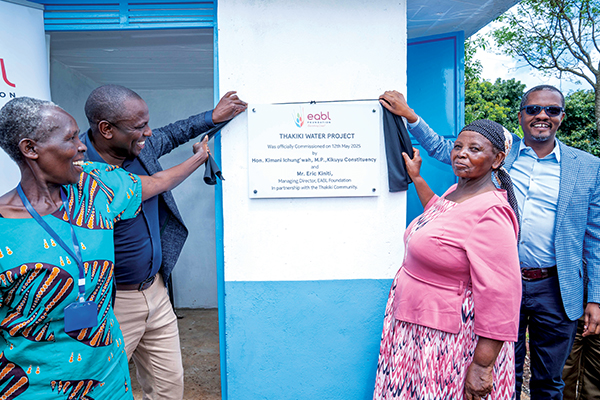
In May 2025, the EABL Foundation commissioned the Thakiki Water Project in Kikuyu Constituency, a Ksh 7.9 million investment delivered under EABL’s Spirit of Progress sustainability platform.
For decades, the Thakiki community relied on seasonal water sources, with residents often walking long distances to access water for drinking, cooking, farming and other household needs. The new project provides a solar-powered pump system, improving access to clean water while reducing reliance on unpredictable sources.
Beyond infrastructure, the project also placed emphasis on community ownership and inclusion. Working with CARE International, the Foundation supported the development of a Gender Inclusion Toolkit, which trained residents on water resource management and promoted women’s representation in the governance of the facility.
Speaking during the commissioning, Eric Kiniti, EABL’s Group Corporate Relations Director and Managing Director of the EABL Foundation, described the project as more than a water access intervention. “Water is life, but for Thakiki, this is more than just a borehole. This is about restoring dignity, unlocking potential, and securing the future. We are happy to embark on this path with the Thakiki people, investing not only in equipment but also in equity, inclusiveness, and long-term resilience.”
The Thakiki project forms part of a broader water investment agenda that includes more than Ksh 780 million invested in water recovery and reuse facilities at EABL’s Nairobi and Kisumu breweries.
Protecting the Upper Tana Watershed
EABL’s water work also extends beyond community access to the protection of critical water ecosystems.
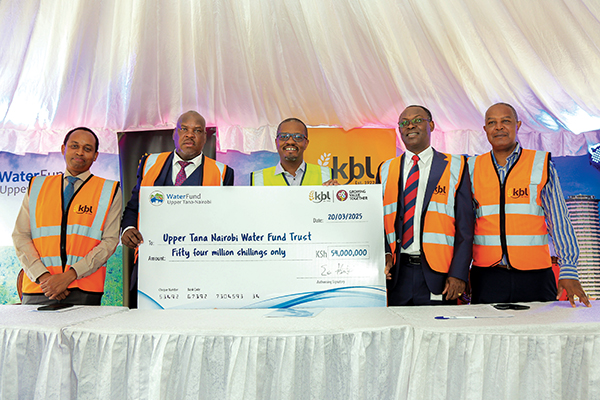
Kenya Breweries Limited, an EABL subsidiary, entered into a Ksh 54 million agreement with the Upper Tana-Nairobi Water Fund Trust to support watershed conservation in the Tana River basin. This builds on an earlier Ksh 190 million pledge made in 2024 and reflects the company’s continued partnership with the Trust.
Established in 2015, the Upper Tana-Nairobi Water Fund Trust was the first water fund of its kind in Africa. The Upper Tana watershed is one of Kenya’s most strategic catchments, supplying the majority of Nairobi’s water and contributing significantly to the country’s hydropower generation.
For EABL, the partnership is closely tied to environmental stewardship, community resilience and long-term business sustainability. “Our collaboration with the Upper Tana-Nairobi Water Fund Trust demonstrates KBL’s commitment to safeguarding our critical resources,” Kiniti said. “By working together, we hope to ensure the availability of clean and safe water for our communities, promote agricultural livelihoods, and contribute to the general health of our environment.”
Alongside its watershed conservation commitments, KBL has invested approximately Ksh 850 million in water recovery units at its Nairobi and Kisumu facilities, with the capacity to recover 1,968 cubic metres of water per day.
Farmers as Conservation Champions
In January 2026, EABL’s Group Managing Director and CEO Jane Karuku, who also serves on the Upper Tana-Nairobi Water Fund Trust (UTNWFT) Board of Trustees, toured watershed conservation projects in Nyandarua and Murang’a Counties alongside UTNWFT President Eddy Njoroge.
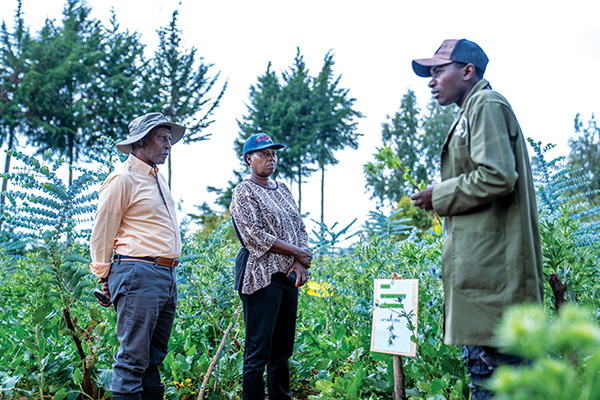
The visit highlighted the depth of the EABL-UTNWFT partnership, which now works with 272,000 farmers to help protect the Aberdare water tower. The catchment is critical to Nairobi and surrounding areas, supplying more than 90% of their water. Through the programme, farmers are adopting nature-based solutions such as water harvesting, terracing, agroforestry and climate-smart agriculture. These practices help reduce soil erosion, improve water retention and strengthen livelihoods.
In Nyandarua, the team visited Joseph Njoroge, a dairy farmer in Miti Iri village, South Kinangop. His land had previously suffered from erosion and water scarcity. With support from UTNWFT, he now has more than 210,000 litres of water harvesting capacity, improved soil health and has become an advocate for sustainable farming in his community.
In Murang’a, the team visited Esther Wandia, founder of Eswaq Tree Nursery in Makomboki. Her certified nursery distributes Hass avocado seedlings across the country while also supporting riparian restoration through bamboo and indigenous tree planting.
Karuku explained EABL’s commitment in practical terms: “We use a lot of water in our manufacturing facilities, so we invest heavily within the organisation to conserve water and replenish the ecosystems from which we get it.”

Njoroge reinforced the Trust’s mission: “The primary goal is to assist farmers to more efficiently conserve the Upper Tana catchment using nature-based solutions while simultaneously ensuring they benefit from their conservation efforts through improved livelihoods.”
A Clearer Water Strategy
Established in 2005 as EABL’s corporate social responsibility arm, the Foundation works across Kenya, Uganda and Tanzania in four key areas: water supply, education and training, environment, and special projects. In recent years, water has continued to stand out as a defining priority, with each new project building on a broader sustainability ambition.
The Foundation’s water strategy works on two fronts. First, EABL is investing in its own operations to reduce consumption, recover water and improve efficiency at scale. Second, the Foundation is supporting community water access and watershed conservation, helping to replenish the ecosystems on which communities and the business depend.
Both streams support EABL’s wider sustainability goal to replenish more water than it consumes across operations in water-stressed areas by 2026. In 2026 alone, EABL has invested more than Ksh 100 million in water replenishment initiatives, including community water projects, reforestation, tree-growing and watershed conservation programmes.
The projects announced over the past 18 months show that this commitment is tangible. It can be seen in a solar-powered water system in Kikuyu, a farmer harvesting water in Nyandarua, a tree nursery restoring riparian land in Murang’a, and water recovery systems operating within EABL’s breweries.
For the Foundation, the ambition is clear: to help secure water not only for today’s communities, but for the generations, livelihoods and ecosystems that will depend on it tomorrow.