
#12
KENYA AIRWAYS
Kenya Airways and Its Commitment to Kenya: More Than Just an Airline
Most people recognize Kenya Airways as the airline that transports them to different global destinations. Fewer people understand what the airline does on the ground. Kenya Airways, also known as KQ and with the tagline “The Pride of Africa,” has been flying since 1977 and has expanded into more than just a transportation firm. It works to make a tangible difference in the country that bears its name by implementing a disciplined program of corporate responsibility, sustainability, and community investment.
Kenya Airways delivers its environmental, social and governance (ESG) commitments through an integrated Sustainability and Innovation function embedded within its business strategy, ensuring sustainability is incorporated into commercial, operational and corporate decision-making.
The airline’s stated aim is to drive Africa’s growth by linking its people, cultures, and markets. Notably, Kenya Airways has direct flights to 15 out of top 20 Tourist source countries as listed by Kenya Tourism Board. Its objective is to become Africa’s preferred and sustainable aviation organization. These aren’t idle phrases. They outline a series of tangible commitments that cover everything from carbon emissions and employee wellness to wildlife protection and gender representation.
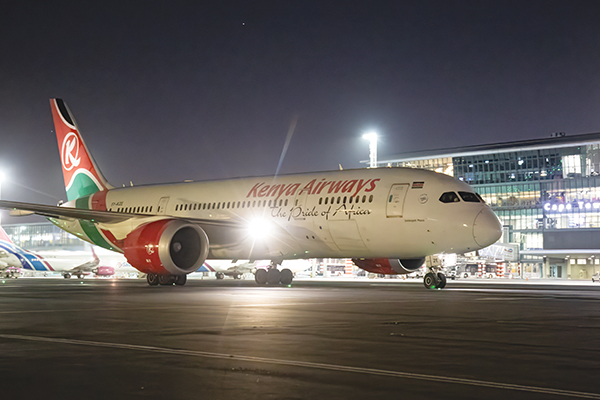
Kenya Airways employs more than 4,400 people, while supporting thousands more across its supply chain, airport ecosystem and tourism value chain.
It connects Kenya to more than 40 global destinations and plays a significant role in the country’s tourist industry, tourism remains one of Kenya’s largest economic sectors. When an airline transports a visitor from Amsterdam to Nairobi, the ripple effect affects tour operators, safari guides, hotel staff, and market vendors all throughout the country.
Reducing Inequality Through Operations
Kenya Airways recognizes its role in creating inclusive economic growth by connecting people, businesses and markets across Africa and beyond.
The airline sees its daily operations as a response to that reality. Connecting Kenyan exporters to worldwide markets makes it easier to ship tea, coffee, cut flowers, and other agricultural items that support rural communities. By training and hiring Kenyans in specialized aviation professions, it creates human capital that lasts beyond any single trip. Through both passenger and cargo operations, Kenya Airways facilitates trade in high-value exports including fresh produce, flowers, pharmaceuticals and manufactured goods.
Kenya Airways has established a structured Innovation Programme that identifies operational challenges, collaborates with business units and external partners, pilots, innovative solutions and scales successful initiatives across the airline.
Environmental Commitments: From Trees to Net Zero
The environmental project at Kenya Airways is perhaps the most ambitious aspect of the company’s corporate responsibility efforts. The airline has pledged to achieve net-zero carbon dioxide emissions by 2050. The airline continues to pursue this ambition through operational efficiency, fleet optimization, Sustainable Aviation Fuel (SAF), environmental compensation products, carbon market readiness and collaboration across the aviation value chain.
The International Air Transport Association (IATA) has set this aim for the whole aviation sector, and Kenya Airways is one of the few African carriers that is taking it seriously as an operational problem rather than a distant aspiration.
In 2024, the airline’s energy intensity was 1.66 megajoules per revenue passenger kilometre, accounting for around 20.28 million gigajoules of total energy consumed.
Kenya Airways benefits from operating within Kenya’s predominantly renewable electricity grid while continuing to improve the efficiency of its own operations. Twelve percent of its ground support equipment is electric,
with a roadmap to progressively increase fleet electrification where operationally feasible. Kenya Airways is actively advancing Sustainable Aviation Fuel adoption through physical SAF uplift on selected European operations, a Book-and-Claim SAF programme for corporate customers, participation in Kenya’s national SAF ecosystem and collaboration to develop local SAF production capacity. The airline has established a target of using at least 10% SAF mix in its operations by 2030. Currently, the airline is working with SAF ecosystem partners to establish local production by 2030.

The airline continues to support landscape restoration and biodiversity initiatives through strategic partnerships focused on measurable environmental outcomes and long-term ecosystem restoration. The Airline has a commitment to plant 1.2 million trees annually.
Protecting People and Wildlife
Kenya Airways has taken a hard stand on two issues that directly affect human dignity and environmental health: human trafficking and wildlife crime.
Regarding human trafficking, the airline teaches employees to identify and report suspected occurrences. It publicly acknowledges the worldwide nature of the problem and has integrated it into its security and passenger-handling cultures. Concerning wildlife trafficking, Staff receive awareness training to recognize, escalate and report suspected trafficking cases as part of Kenya Airways’ commitment to protecting vulnerable people.
Kenya Airways is also a signatory to the Buckingham Palace Declaration and actively supports intelligence sharing to disrupt illegal wildlife trafficking through the aviation sector.
Therefore, as a member of the United for Wildlife Transport Taskforce, a group of airlines, shipping firms, airports, and law enforcement agencies aiming to shut commercial transport routes exploited by wildlife criminals in East Africa and beyond. This membership is not ceremonial. It entails active intelligence sharing and a collaborative response to specific trafficking concerns.
The airline’s K-9 unit works at the airport with trained detection canines capable of recognizing a wide range of chemicals without intrusive screening, providing an additional layer of security for both passengers and cargo operations.
Gender, Workforce, and Wellbeing
Kenya Airways has set a formal goal of employing 25% women in its most male-dominated roles, such as pilots, operations, engineering, technology, senior management, and governance. As of 2024, there are significant gender disparities: women make up 8% of pilots and operations workers, 17% of engineers and technicians, and 17% of C-suite and director-level positions. The airline has been open about these numbers rather than hiding behind broad diversity declarations, which is a more honest approach than most businesses use.
Employee well-being is taken seriously. All employees have access to healthcare and parental leave, permanent employees receive retirement benefits, and an organized wellness program addresses mental health, nutrition, physical fitness, and immunization. Collective Bargaining Agreements include 81 percent of all employees.
Employee wellbeing programmes also include financial wellbeing, psychosocial support and employee engagement initiatives.

Strong Governance Underpins Sustainability
Sustainability governance is embedded throughout Kenya Airways through Board oversight, executive accountability and cross-functional ownership of environmental, social and governance performance. The airline publicly reports its sustainability performance annually and subjects selected key performance indicators to independent limited assurance, reinforcing transparency and accountability.
Helping Customers Decarbonize their Travel
Kenya Airways has introduced Environmental Compensation solutions that enable corporate and individual customers to contribute towards verified climate initiatives and Sustainable Aviation Fuel, helping organizations address Scope 3 business travel emissions while supporting aviation decarbonization.
Piloting Global Sustainability Standards
Kenya Airways’ most notable recent development is its selection as one of the first airlines to trial IATA’s new Integrated Sustainability Programme (ISP), which was announced in May 2025.
The ISP is a new global framework designed to assist airlines, airports, and ground service providers in improving their sustainability standards in three areas: responsible procurement, social responsibility (human rights, labor conditions, and community engagement), and data-driven sustainability performance monitoring. Kenya Airways collaborated directly with IATA for a week to stress-test the programme, offering operational feedback and real-world context to help build a framework that works in practice rather than just on paper.

Kenya Airways was praised by IATA leadership for its approach to integrating environmental and social responsibility in African aviation.
The ISP’s formal global introduction is scheduled for the IATA World Sustainability Symposium in October 2025, with Kenya Airways anticipated to pursue full certification after the pilot phase.
Through its Innovation Challenge programme, Kenya Airways is working with employees, business units and technology partners to solve operational challenges, improve efficiency and accelerate digital transformation across the airline.
Kenya Airways continues to strengthen accessibility across its operations, recognizing that inclusive travel improves customer experience while opening new market opportunities for passengers with disabilities.
This accolade is significant for an airline that has experienced financial difficulties in the past. It demonstrates that Kenya Airways is not only surviving but also setting the standard for sustainable aviation on a continent that the rest of the world is eagerly watching. As the aviation industry accelerates its transition towards a more sustainable future, Kenya Airways is positioning itself as one of Africa’s leading sustainability-focused airlines—combining operational excellence, innovation, responsible governance and environmental leadership to create long-term value for its customers, communities and the continent.