#14
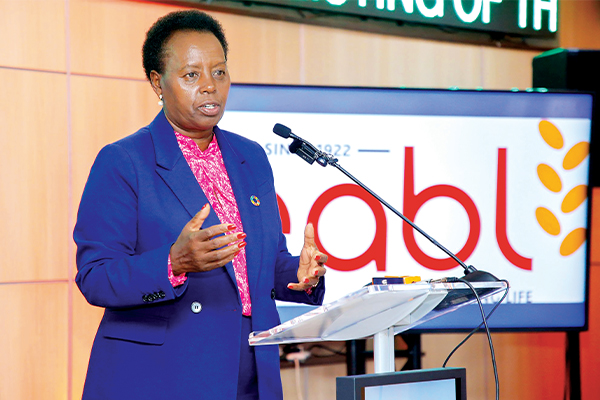
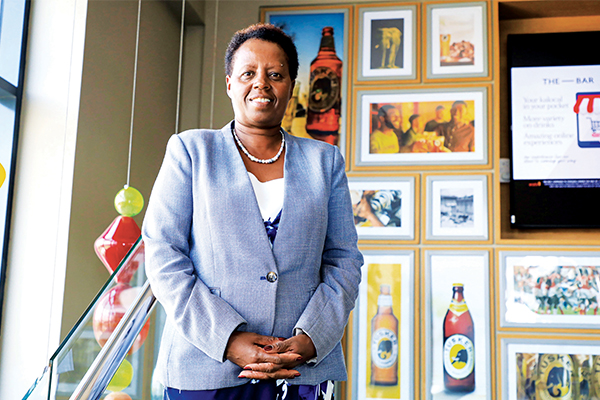
JANE KARUKU – MD&CEO EABL PLC
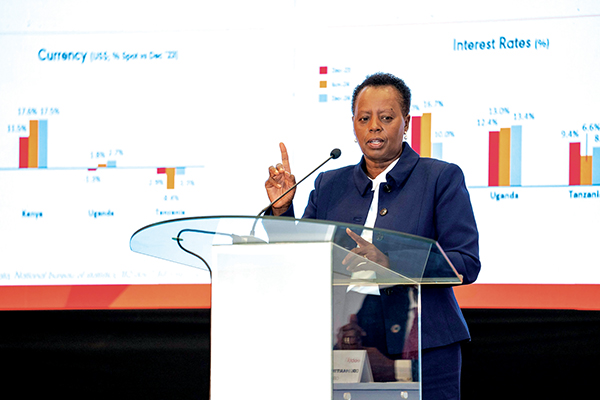
Businesses operating across East Africa must constantly balance opportunity with uncertainty. Inflation trends, currency movements, regulatory shifts, and interest rate fluctuations shape how companies plan, invest, and grow. For East African Breweries PLC (EABL), Group CEO Jane Karuku has navigated these forces with clarity and resilience. The company’s results for the year ending June 2025 reflect not only disciplined leadership but also a deep understanding of the evolving consumer and market environment.
Kenya, Tanzania and Uganda, all posted positive economic growth. Exports markets in the wider EAC, Europe, Asia and the US also reported some modest growth. In Kenya, EABL’s biggest market, inflation eased significantly, and interest rates softened, providing a much-needed boost to both businesses and households. Even so, consumers continued to feel the strain of rising living costs. Many reduced discretionary spending, shifted to value-driven choices, and carefully evaluated where and how they spent their money.
Alongside this caution, however, was a countertrend that has taken root across East Africa: rising affluence and a growing appetite for exploration. Consumers particularly younger, urban demographics showed a willingness to trade up to premium brands, experiment with new flavours, and embrace sophistication in their drinking experiences. The global shift toward moderation also found expression in the region, with increased interest in low- and zero-alcohol offerings. This duality, cautious cost management on one hand and bold premium exploration on the other defined the year’s consumer behaviour.
EABL’s performance reflected this complex landscape. The company recorded 2% growth in volumes, 4% growth in net sales, and a 12% jump in profit to KSh 12.2 billion. Bottled beer and premium spirits continued to outperform, supported by a stable tax policy. In particular, the Kenyan Government’s decision to hold excise duty on beer steady for two consecutive years created predictability for manufacturers and consumers alike, an outcome made possible through sustained industry dialogue.
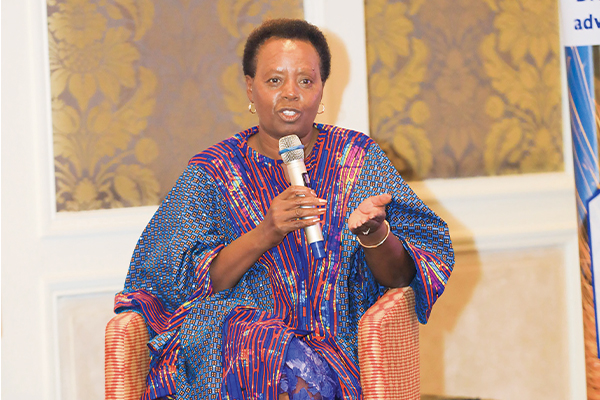
That dialogue has been greatly supported by Ms. Karuku’s leadership beyond EABL. Since her appointment as Chairperson of the Kenya Association of Manufacturers (KAM) in July 2024, she has been instrumental in championing policy frameworks that foster competitiveness, encourage local production, and ensure the long-term health of the manufacturing sector.
Innovation remained one of EABL’s strongest engines of growth. The company continued to reap the benefits of investing in homegrown creativity across both beer and spirits. Heritage brands such as Kenya Cane, Uganda Waragi, Tusker, Bell, and Serengeti expanded their influence through bold new variants tailored to shifting consumer preferences. Flavoured innovations like Tusker Ndimu, Serengeti Lemon, Bell Citrus, Kenya Cane Lime & Ginger, and Uganda Waragi Coconut and Pineapple became regional favourites each grounded in meticulous research and a strong pulse on culture and lifestyle trends.
“As a business, we are always watching, researching, and understanding how consumer dynamics are evolving,” Ms. Karuku explains. Today’s consumers want more than a drink: they want flavour, choice, and experiences whether entertaining at home, exploring new social spaces, or seeking lighter alcoholic options that reflect wellness priorities.
This insight fuelled the development of Manyatta ciders, launched in late 2023. The brand has quickly gained traction among younger, flavour-seeking drinkers and is now one of EABL’s standout innovation successes.
To accelerate this innovation pipeline, EABL established the Tusker Brewhouse, a microbrewery designed for experimentation and rapid product testing. It allows the company to produce small batches, gather immediate consumer feedback, and refine offerings before scaling. Manyatta and Tusker Ndimu were first crafted here, evidence of the Brewhouse’s power to fast-track ideas into commercial successes.
Yet, even with strong innovation and stable growth, one stubborn challenge persists: illicit alcohol. Rising across East Africa, illicit consumption has seriously affected mainstream spirits. Ms. Karuku describes the market as taking the shape of an “ugly hourglass” rapid growth at the premium end, a squeezed middle market of mainstream brands, and an expanding bottom dominated by illicit and ultra-cheap alternatives. The situation is most severe in Kenya, where illicit alcohol now represents 60% of all alcohol consumed, leaving compliant manufacturers to compete for just 40% of the market.
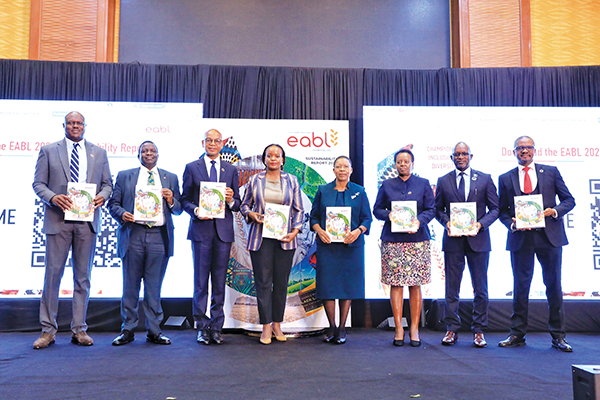
Navigating such a landscape requires precision. For EABL, success lies in remaining close to the consumer, investing wisely, driving productivity, staying ahead of trends, working collaboratively with regulators and nurturing a focused and motivated workforce.
The broader lesson from EABL’s 2025 story is clear: in a market defined by complexity, resilience is not passive. It requires curiosity, innovation, collaboration, and courage. EABL’s ability to deliver growth, champion industry interests, and shape consumer culture across East Africa is a testament to leadership that does not simply respond to change but anticipates it.
With its eyes firmly on the consumer and its commitment to innovation stronger than ever, EABL stands well-positioned to continue shaping the region’s beverage landscape. The journey ahead will demand agility and bold thinking, but as the company has shown, progress is built on insight, innovation, and one determined step at a time.